Wednesday, October 25, 2023

How to Avoid the Ice Crazies

As with any isolated environment, keeping yourself entertained is vital. You can't just work and sleep for six months, you've got to stay stimulated. I'm not much of a hiker or outdoorsman, so if I'm looking to have some fun or distract myself, it'll be inside. Most of the activities that go on around here are led by individuals, though the station does put on the occasional activity through official channels. But there's plenty to do if you know where to look.

For starters, each residential building has a lounge on each floor. They've got comfortable chairs, at least one TV, and bookshelves full of books and board games. These are the "designated" hang out spots and are more often than not meeting places for things like movie nights and watch-alongs. I'm sure it's no surprise to anyone that I've heard of a few different The Thing movies nights for Halloween—it's basically a tradition. There is also the opportunity to watch movies and shows in your rooms. Each dorm room also has a TV, but it's likely more work to coordinate around your roommates schedules. As a mid-rat, working and sleeping weird hours, my roommates are usually considerate enough to not bring friends in and party while I'm sleeping.

For those who can't hang in their room too much, the galley is a popular hang out spot as well. I've seen many a board game night while going in and out of the kitchen. Since the bar closures, the galley has become a general spot for people to congregate, even if it's just to talk or grab a late night snack. If you don't mind being slightly underfoot as the stewards do their job, it can also be a nice place to focus on your own work. I often grab a table in the galley to get some writing done (like I am right now!).

For those with a crafty proclivity, we have our own craft room on station. Supplied with plenty of yarn, paint, paper, and other supplies, plenty of people find unique ways to create. And while I'm sure it's nice to work on your own, there are dedicated nights to craft as a group, with stitching circles and painting groups set up to encourage one another. We also have access to Gear Issue and their plethora of indoor activities. While they also have board games and such, I was most surprised to find they have older generations of gaming consoles. If you want to rent a PlayStation or Xbox, they've got all you need to hook it up to the TV in your room, games included!

While our jobs keep most of us pretty busy and sweating, I wouldn't call it exercise. So if you had a fitness routine before coming down here, you might be concerned about maintaining your healthy lifestyle. Well fret not, while we in the kitchen can't help you with your food macros (or how many cookies you take), there are facilities to keep yourself in shape. There are three gyms on base, each with a separate purpose. The furthest out and probably least used is the sports gym. It's got a full-sized basketball court and doubles as the pickle ball court. It also has a small climbing wall you can be trained to use. The second gym is the weights and aerobics room, which is connected to the main building (and has a secret passage to through the kitchen, but don't tell anyone I told you). The aerobics room is your standard open room with mirrors on one side. People host different classes there, from yoga to martial arts to dance. Connected to it is the weights room, which has a wide selection of free weights and benches, as well as a maybe fifteen different machines in total. Anything you can do at Planet Fitness, you can probably do here. Finally, there's the affectionately named Gerbil Gym. This is the gym I've mostly been using as it is filled with treadmills, ellipticals, stair climbers, and my personal favorite, rowing machines. If the harsh climate of the outside is too much and keeps you from hiking, you can still get your heart rate up here. While I'm still starting out, I hope that doing regular rowing will build some healthy habits for me.

There are also some unexpected opportunities, if you want to try something new. While the bars don't serve alcohol, they still serve as a meeting place and every Friday they play host to trivia night or karaoke. There's a station radio program and you can sign up for your own time slot show; it reminds me of the radio shows I did in college. There's a library available as well, though the hours are dependent on the volunteers, and I have yet to have a chance to explore it (not to mention I thrifted enough books for a while).

Much like food, entertainment is morale as well, and in an isolated environment like this, you need everyone in as good a mood as possible. A big part of that is on us, however. It's about getting to know your coworkers and people on station, making good connections, and enjoying life together.

Next week, I'll be sharing some of the interesting things you can do outside, if you're willing to brave the climate. 

Wednesday, October 18, 2023

Picking the Bones

One of the biggest stressors for me (and my mother) when I was packing was whether I would have everything that I needed—Do I have enough socks? Should I bring my own shaving cream? Face wash? Soap? Should I bring snacks that I might miss? Am I bringing the right kind of thermal layers? Question after question. And the cloud hanging over all of it was: what do I do if I do need something? Not like I can pop down to the local Walmart or get two-day delivery from Amazon. And I think they frown on hunting penguins for their down.

But I'm not the first person to have this concern. Even for returners, there's the weight of getting what you need and holding onto the things you brought. But if you find yourself in need, there's a place here you can search for your heart's desire: Skua. Skuas are carrion birds that feed here in Antarctica. If there's something out there they can eat, they'll pick it clean. That ethos is what led to naming the "thrift store" on base.

Skua is a building at McMurdo that is the final (or temporary) resting place for anything that previous staff brought with them and didn't want to cart back home. Anything from clothes, bedding, and shoes, to books, technology, spices, and more, all end up in Skua, waiting for their next owner. If you found that you didn't have a warm enough blanket, Skua likely has one. If you broke your alarm clock, Skua has another stashed away. If you want something to read and Library hours are just not jiving with your schedule, Skua has plenty of trash novels to pick from (I should know, I picked up thirty-five of them for my room).

(My treasure trove)

And the best part of this time period is that the winter-overs are leaving, meaning they're dumping all their stuff for Skua, and at the same time, Main Body still hasn't shown up in full. So for those of us here and staying, there's a treasure trove of new nonsense to pick through. And it's all free! Frankly I'm glad my father isn't down here as he'd dedicate a whole suitcase to return with things he could use back home. Free is a good deal, after all.

Skua will likely cover any incidentals that you might need, and some things you didn't even know you wanted, but what about limited quantity items. Just because bacteria growth is hindered in this cold doesn't mean you can lay off the soap. And some people can't live without their Red Bull, so if we want a smooth kitchen shift, there needs to be a ready supply. Thankfully, commerce is alive and well on The Ice and we have a proper store on base.

While certainly not the Mall of America, the McMurdo store has plenty of the essentials for daily life, along with the luxuries that get you through the day. As expected, there's plenty of toiletries and daily necessities. I brought plenty of my own cold medicine and Tylenol, but there's a full suite of over-the-counter medications and vitamins. For those here in winter, when it's all darkness all the time, a ready supply of vitamin D is crucial. There's soaps, shampoos, and other cleaners—which experienced staffers tell me creates an interesting problem where everyone eventually smells the same and you go even more nose blind. Everything to keep you decently healthy and clean can be bought in some fashion, even if it's the cheap stuff. If you've got a complicated skin routine, make sure you bring your own supplies.

But it's not just about staying alive—morale is important too. We've already covered that alcohol is available and important to many down here, but the breadth of available product is rather impressive. While there's some amount of wine and spirits available, there's a whole wall dedicated to beers and such. Although if you want your favorite, get there early on restock days. Otherwise you'll be left with the Coors Light or whatever undesirables are left over. For those of us who don't drink, there's a regular rotation of sodas available—again, your favorite might not be there or be in limited supply, so learn to make do when you can. There's also a ready (and rotating) supply of candy and snacks, for those like me with a fiendish sweet tooth. So while you can't always guarantee something, there's plenty of tastes of home for us to enjoy.

Of course there's also plenty of Antarctica swag in the store. If you want shirts, hoodies, sweatpants, patches, or stickers with McMurdo and Antarctica iconography on it, it's available in spades. How else are you going to let people know you came to the edge of the world if you don't rep it on your knit cap? Jokes aside, they are pretty decent quality, and I'm sure many people, myself included, bring them home as souvenirs for their friends and family.

If I do come back for a second season, or again at a later date, it's good to know that I don't need to stress as much over every little thing that I "need" to bring down here. There's plenty I can buy to sustain myself, as well as people smarter than me leaving their treasures behind to be used. Really, it's a statement to the community mindset of McMurdo that Skua is such a great option and that those leaving want to share their supplies with us left behind. And when I leave, I'm sure that I'll leave some useful items for those who come next, to make their lives a little easier and more comfortable. Like others did for me.

And though it pains me, yes, I'll leave behind the novels I finish reading. And those that I don't, I guess. Maybe.

Wednesday, October 11, 2023

The LiDAR Tour or Why Todd is Not a Scientist

I'm going to preface this by saying, "I am not a smart man." There's a lot of science talk that goes way over my head, so as cool as this experience was, I'm definitely going to misinterpret some details and forget others. But hopefully this will be a foundation for further inquiry if it catches your interest.

Despite what my previous articles might indicate, Antarctica is not just booze and leftovers with cheese; there's actual science that happens here! The reason we're all here is because Antarctica provides a unique environment for exploration and discovery, and people like me support them. Recently I got to visit one of these science fields and hear about the research they are doing.

I had the chance to visit the New Zealand LiDAR system. And if you're anything like I was when the tour was announced, you might be wondering what a LiDAR is? As I understand it, it's basically like a radar system that uses light instead of radio waves. By using different kinds and frequencies of lasers, the scientists can detect the light refracting off of material to measure certain properties of that material.

At the LiDAR we toured, they were measuring iron and sodium in the metallic vapor layer of earth's atmosphere. Because apparently earth has a layer of metal floating above it all the time! Didn't know that. But by using a specific green laser and a headlight yellow laser, the system can detect the metal and draw conclusions. How it works is that the laser is shot into the air at the resonant frequency of the metal the team is trying to detect. Once it hits that metal in the atmosphere, it refracts off of it and is "caught" by giant telescope lenses back at the station. Using a spectrometer, they get a bunch of data from the test and can move on from there.

So light is the key element at work here. That's one of the reasons that this facility is down in Antarctica. Over the winter, there are months without sunlight, meaning that there is no solar interference that they have to filter through when reading the data from their laser. That said, their system is apparently real smart and can filter out the sun's light pretty well, although it still works better at night.

The metal layer is apparently made up of more metallic elements than oxygen—less air than metal. I don't know what to do with that fact, but I thought it was neat. But that also makes it easier to read certain data points. One thing we were told is that they can learn about the wind speed at that altitude. It's too high for weather balloons, so normal measurement tools aren't as useful. But when using the LiDAR, they can tell if the metal particles are moving and how quickly, giving them a picture of the atmospheric shifts going on up there.

That's pretty cool, but the question as always is: how is this practical? Glad you asked! From the scientist who gave us the tour, this data can show us:

  • How energies at the pole interact
  • How waves transfer energy
  • How the atmosphere reacts to energy inputs
  • How the metal layer effects weather models

I don't know what any of those actually mean! I'm just retelling you what he told us. But this does seem to have some level of use and interest. One of the women that was with us said that her daughter's boyfriend wanted to study this exact thing—which A: small world, and B: seems really specific and I don't know how someone decides that's going to be their specialty.

While we were there, we also had a chance to see some meteors falling, including one of the brightest and greenest shooting stars I've seen in years. It actually prompted an interesting discussion with our guide. Meteors like that are a big reason that the metal layer exists—various kinds of space debris comes into our atmosphere and doesn't make it to land, but burns up and stays in the metal layer. I asked how much that one meteor might add to the layer and apparently that's a really big question in this field. No one really knows, but estimates are that a shooting star like we saw could add literal tons of metal to the metallic later.

I hope that while I'm down here, I can see other scientific efforts and the cool things they're working on. While I didn't understand a whole lot of what we were shown, I did appreciate the brilliance and unique approaches that the scientific world can use in a land like Antarctica. It puts into perspective the "laymen" work that I and the others do to keep this place running. There's a lot of cool things happening, even if I don't see or understand all of it.

And let me just say it took a herculean effort not to look into the one laser we were shown.

The yellow laser used to measure sodium. It's the one that would be most easily visible for us on the tour.

Wednesday, October 4, 2023

Last Call for the Bar at the Edge of the World

This might be the closest thing to breaking news that this blog will ever cover. At the time of writing, the bars—Gallagher's and Southern—have stop serving alcohol.

First off, if this is a surprise to some of you: yes! We do have (had?) functioning bars at McMurdo Station. Alcohol was regularly served after the normal workday and both were popular for those who were not working late or overnight. If there is a social heart at McMurdo, it's the bar.

There has, however, been rumblings and requests for a while now for more alcohol-free spaces. Not everyone on station drinks—myself included though this was in the works even before I was hired—and the opportunity to treat some more problematic behavior in the community must have made this an attractive opportunity for the McMurdo leadership. So after one last hurrah, alcohol service was ended and both bars have become monitored hangout spots with opening and closing hours, rather than the 24-hour lounges they were before.

This does not mean, however, that alcohol is banned or that McMurdo is a dry station (though we'll get to that later). As is fitting for what was previously a naval base, everyone has an alcohol ration they are allotted and are able to purchase alcohol of varying kinds from the McMurdo store. The bars were apparently not part of that ration, so now there's a limit to the amount of alcohol someone can consume on a weekly basis. So while they won't serve alcohol at the bar, you can bring and consume your own alcohol there (the bars will be serving sodas and other soft drinks, but I highly doubt anyone will really be paying for those).

Hopefully that serves as an introduction to the bars and alcohol in general on station. We're going to talk a bit about why they made this change and whether it will be effective or not. As a fair warning, much of this will be based on speculation from myself and other coworkers that I've spoken with, as well as some rumors that have been going around. How true these rumors are remains to be seen, but their validity doesn't have any effect on how people live their lives once hearing them.

So to begin, I actually think this may have been a good move on station management's part. Both for the health of the station workers and for their safety. By health, I mean the obvious stuff. If my last post didn't hammer it home enough, slips, trips, and falls really are the most common form of injury on the station. And if we know anything about alcohol, it's that coordination often goes right out the door; not to mention thinning blood and susceptibility to cold, both of which are obviously bad here. But all of those can be mitigated with careful consumption, a "designated driver," and general self-control.

But more to the matter is safety. The United States Antarctic Program has a few skeletons, as any organization does, but also being a government entity, they are fairly well documented. While not a pattern, and certainly not such an epidemic as to warrant major safety concerns for those of you back home, there are many documented instances of harassment and inappropriate behavior on station. And the most common factor among those events is alcohol. I doubt I need to outline what happens to inhibitions and decision-making when alcohol is overly involved. So in an effort to stem and eventually stop these kinds of behavior, shutting down the bars might be a first step to totally shutting down intoxicated misbehavior.

There's talk about making McMurdo an entirely dry station—no alcohol whatsoever (except to cook with, but if you drink that, I pity you). It honestly may not be the worst idea. Despite being a science base, McMurdo has a bit of a reputation as a party place. Drinking is the national sport down here. I've been told by returning staff that some people that come here actually lose money because of how much they drink. When room and board are both covered and you have really no bills, that is an obscene amount of alcohol to drink. As one of my coworkers pointed out, this place isn't spring break. You are expected to work and work well. You don't come down to party and then drag your hungover body to your job. If the party culture is that prevalent, it could be getting in the way of quality work and a safe work environment for others.

So if the goal is to change the culture of McMurdo station and protect the individuals that work here, I think having to cut off a limb to save the body is the right step. What's important will be to see how leadership follows up with this to offer new opportunities for staff as well as outlining a plan going forward. Keeping your workers in the dark about plans often leads to unease and a lack of faith in upper management. But the keen-eyed of you might have picked up on a flaw in this proposed solution.

When I talked with my coworkers about this, I asked two questions: was this decision well-thought-out? And will it work as leadership wants it to? I think we've come to the conclusion on the first part that there is a worthwhile intent behind the change, and that it may have been thought through. But will it work like they want? While the bars will not be serving alcohol, we still have our own ration of alcohol.

You know what they say about good intentions, the road to hell is paved with them. Stopping sale of alcohol at the bars could theoretically limit the amount of drinking, but it also opens new problems. In general, this is where much of the dissatisfaction comes from on station. And there are a few points to consider.

The first is that this doesn't necessarily limit the amount people will drink. While the alcohol ration is limited, it is also weekly and can (and probably will be) stockpiled. There's no real limit on what people can do with their own property. One of my coworkers said that the problems they faced related to alcohol happened away from the bar. People's actions will still be effected by their drinking. And linked to that is that it will no longer be localized to one area. Now that the bars have regular hours, people will need to find new places to take their after-party. The only real options are the galley, the dorm lounges, and their rooms. That means that any additional alcohol-influenced behavior is going to happen in more secluded and "residential" places. What might have been avoided at the bar could well fall into someone's lap while "home." As one kitchen member said, if someone wants to act like a hooligan, they will, regardless of location.

Next up is that this basically begs for a black market to be created. I've mentioned before, but I'm not the only one who doesn't drink. Other people aren't using their alcohol ration for their own enjoyment. But everyone still has one, even if they don't use it. So what's stopping someone from using their ration and then turning around and selling the alcohol to those who do want it. Yes, there are rules against that—misappropriation of government assets or something—but that's what makes it a black market. Supply and demand often makes it worth the risk to some people. People will get their alcohol, one way or another.

And third, this is taking away public space. What used to be a hangout spot is now limited in when it can be used. The initial push was for more alcohol-free social zones, but with the bars closing as they are, that leaves even less space for casual socialization. There's now the galley, which is now sort of the bar #2, there's the dorm lounges, which all fall under the 24-hour quiet hours rule, there's the craft room, which is only open at certain times, and there's the rec room, same issue. And there has been a rumor going around that if things like the rec room aren't being used enough, then it will get changed over to office space, further limiting the amount of social spaces. I don't think we're asking for a whole new building to be erected here for the sole purpose of board games and book clubs, but by taking away a social space and not filling that void, it really feels like the walls are tightening around the staff. If you don't hike or ski, do you really have a place here to relax uninhibited with friends?

This has obviously not been an extremely popular choice among the staff. There's even been a rumor that some forty people backed out of their contracts when they heard the bars were closed. With only around 900 people expected this season, that's not an insignificant number. And many people that I've talked to just think this is a bad idea.

For me, it's been a very interesting week. I don't have a dog in this fight; I'm not drinking while down here. But my investigative journalist has been stirred and listening to people and asking questions has been very enlightening. If I had one take away from this, it would be to encourage leadership to be open and honest about what they want to achieve and to have a set plan on how to get there. People are not happy right now, and part of that is the ambiguity. You've taken a "toy" away and not really explained why. That's going to foster some resentment. If this is going to be a cultural change, embrace that and let the chips fall where they may. The people that will come back after the fact are those you want if you're doing something new.

And for everyone else, drink responsibly.

Stay cool everyone.

Wednesday, September 27, 2023

The fact that kitchens function at all is a miracle

Hopefully after being here over a month, I can wrap my head around what a day in the kitchen looks like. For those of you who have been in food service, I'm sure this won't be too out of the ordinary for you. Even at the edge of the world, people need to eat and the ways to get food out to them are still pretty standard. There's a lot more to the logistics of it and I hope to get a chance to talk in depth with Executive Chef Rob Greene about that for a later article. But from fridge to plate, it's easy enough to understand.

As a caveat before we begin: during the main body season, the kitchen technically runs 24/7, with a new shift called Mid-rats (which someone once explained what meant, but my quail brain has since forgotten). This overnight shift currently isn't active, so I can't tell you too much about it, but just know that when everyone is here, there's always an opportunity for food.

Anyway, things start off with breakfast and the kitchen opens at 4 a.m. Breakfast is a pretty simple affair, usually consisting of scrambled eggs, home fries, some kind of protein like bacon or sausage, and some sort of additional breakfast entrée like a breakfast casserole or French toast. We also have one of our Action Stations open, the egg line. If the buffet options aren't cutting it, you can come in and order some fresh made eggs or an omelet. Unsurprisingly, the egg line is probably the most popular spot in the morning, but breakfast as a whole is currently pretty sparsely attended. The early morning is mostly handled by one guy, Marty, and when I was working the a.m. shift, he was typically done with the line by the time I arrived. (I feel as though Marty has been unfairly banished to the mornings because people got tired of his dad jokes. Stay strong Marty. Every workplace needs a Marty.)

The next shift to start is the a.m. shift. This typically begins at 5 a.m., though on Sunday it starts at 5:30 as that is Brunch day and breakfast is basically cancelled. A.m. is mainly focused on lunch. The goal is typically to have everything prepared (or mise'd from the term mise en place) by 7:30 as that is when the first a.m. break is. Then from roughly 8:15 on it's time to get lunch together. We're on a five-week menu rotation, so even for how long I've been here, I don't think I've seen everything that we put out. All that to say that there's really no one consistent thing about a menu I can share as an example, but methodology is typically the same. We use four big ovens, three tilt skillets, a four-well fryer, two steam "ovens," some giant steam jacket vats, and the most jank stove top on earth that we try to never use. There's a lot of ways to get food hot is what I'm saying.

At 11 a.m. is when the p.m. shift begins. Similar to the a.m. shift, the goal is to get everything mise'd out before the 1 p.m. lunch break and to come back from that ready to put together dinner. Having worked both shifts now, they're pretty similar in how things are managed and how dishes get put together. As long as it tastes good and gets out there on time, we call that a win.

There are also two additional elements in the kitchen. First is the bakery. Bakery keeps us stocked with cookies in the to-go box and all kinds of interesting desserts for meals. As someone with a fiendish sweet tooth, I have nothing but respect for the bakers, long may they reign. The other is the "garde manger" if you're being proper, or salads if you're being at all practical or useful. As expected, they take care of the cool ingredients and yes the salad, but as lettuce is a rarity down here, "salad" tends to be a broad term, often including pasta salads and the like. I fully admit I haven't spent a lot of time paying attention to this area. Once you start setting up a chocolate chip cookie salad, hit me up and I'll be there post-haste.

As mentioned before, we also have Action Stations. These are for made to order or made live items. Again, egg line is at breakfast. The famous McMurdo Garnish is our pizzas, which is currently only done three times a week, but is going to be daily, 24/7 when main body hits. Having worked the pizza stations a few times, it's a surprisingly fun time. We'll also do different one offs like burgers, burritos, and steak carving. None of those are on a set schedule, but come up as the wind takes us. There's been talk about doing Action Stations every day once main body arrives, and that's apparently a new thing, so we'll see how that goes.

There's a lot of moving parts in a kitchen and many different ways to approach the tasks and check lists, but at the end of the day, the goal is always the same: make a meal people can enjoy. I'm fine with doing a lot of the grunt work and letting the more knowledgeable leaders keep things on track. If you need someone to dice fifty pounds of onions or peel seven bags of potatoes, I'm your guy. It's a lot of expertise and experiences that make it all function and I'm frankly amazed that any amount of people actually end up fed, let alone every meal every day.

Now, back to that chocolate chip cookie salad....

Wednesday, September 20, 2023

A Mandatory Health and Safety Brief

This is not, in fact, about kitchen safety. If you've worked in one kitchen, it's all basically the same: wear nonslip shoes, change gloves often, don't stick a finger in the meat slicer—the usual. No, safety on the Ice is a lifestyle. How else are you going to avoid slips, trips, and falls injuries?

Antarctica is one of, if not the, harshest climate on earth. So to say that the National Science Foundation and the partnering companies take safety very seriously is an understatement. If the discussion on conditions last week didn't give the whole picture, everything is tied to the weather here and how to mitigate the damage that it can do to property and person. If you want a tangible perspective of how important they take safety: all the new people were allowed to leave work for a few hours to attend a safety lecture. If a company wants you to not work to hear this, it's got to be important. Maybe more important than avoiding slips, trips, and falls injuries.

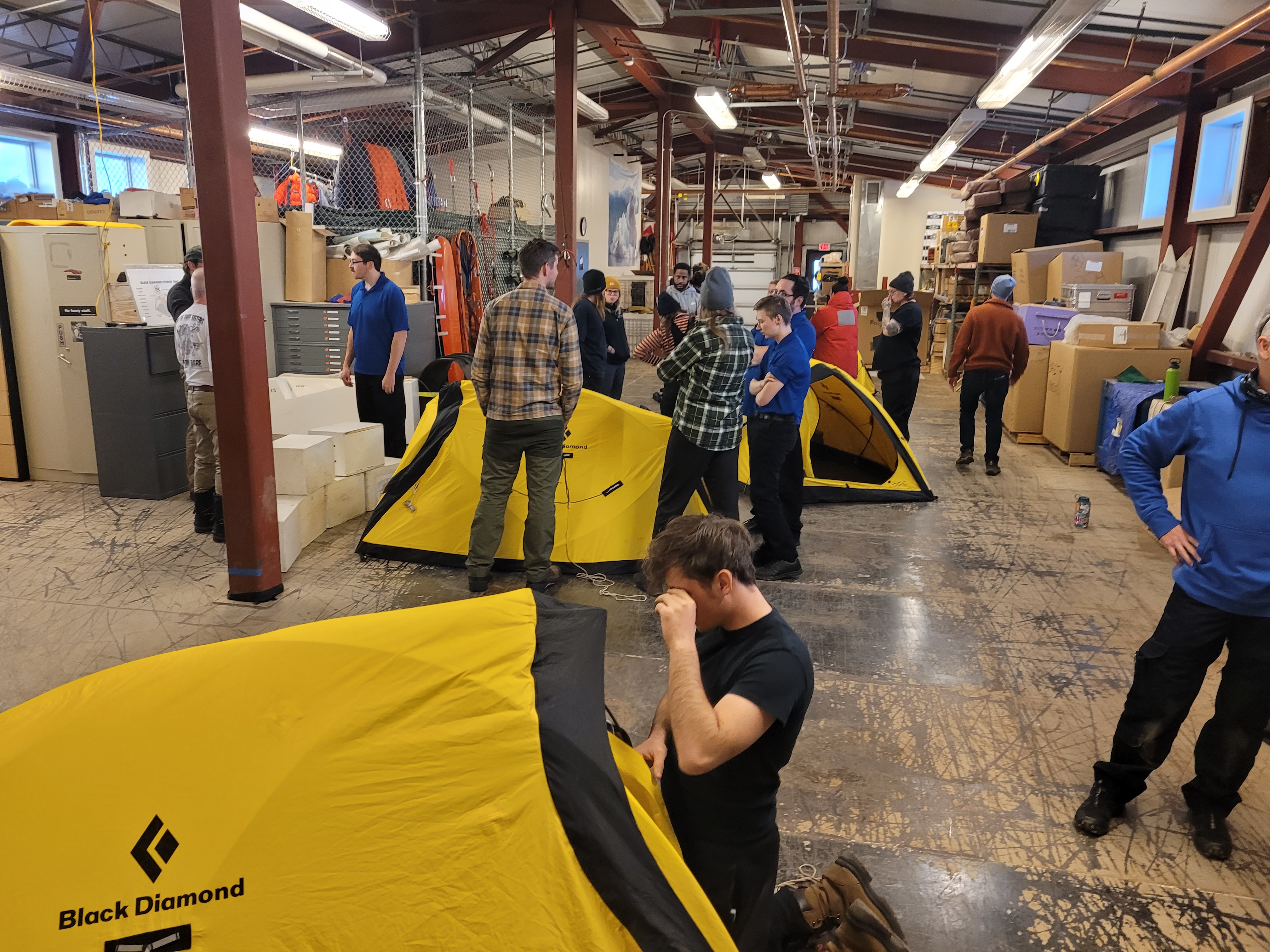
For example purposes, we're going to talk about the Arctic Field Safety (AFS) training—the one I got out of work for. The purpose of this training was essentially risk management by way of survival training. There's an ever-present opportunity to be out and about in severe weather, either by choice or by necessity, and while life around the station can be fairly safe, that's less true as you go out on excursions, hikes, or leisure activities. To give you a lifeline should anything go wrong and you are trapped outside for an extended period, we were shown what the Survival Bag is and how to use the items included, including how to treat slips, trips, and falls.

The best way to start off a any lesson is with fire, so we learned how to use small gas stoves that you pressurize yourself.

The whole fire set is included in the Survival Bag, along with a basic first aid kit, a saw to cut the snow and ice, stable meals, sleeping bags, a grab bag of additional cold weather gear, and a tent, along with some other odds and ends. One bag can support two people for three days.


Setting up the tent was more complicated than we initially thought. I think all of us were glad to not have to figure that out when actual survival was at stake. And it's hard to slip, trip, or fall in such a low tent.

We also learned a fair bit about frostbite and ways you can get it, even when you're being careful. Our instructor shared one story of a mountain climber who on the final journey to the top of a mountain put on an extra pair of socks as it was colder that day. When he got down, from his toes to the balls of his feet were blistered and frostbitten. It happened not because it was so cold, but because the circulation had been diminished. This is also the first place I've heard the term "frostnip," which is apparently an early sign of frostbite and tends to happen on exposed areas like ears and the nose. The pictures were bad enough—not something I want to experience in real life. Like slips, trips, and falls injuries.

All of this orbited a discussion of risk; how the odds of something happening and the severity of the outcome had to be weighed in all circumstances. Weighing risk and making choices is about judging the likely hood and the consequence, identifying ways to mitigate one or the other, and ultimately acting on it. That's the thing about being in Antarctica. If you want to go for a hike, not only do you need to be aware of what could go wrong and what to do about it, but you're required to make decisions about whether it is even wise to do something in the first place. Luckily we have lots of trained professionals to help make those decisions, so even if I did want to go hiking with a herbie on the way (herbie is what they call a storm with high wind and snow—I only learned this in the last week), communications and recreation staff wouldn't allow me to. They know how easy it is to slip, trip, and fall in weather like that.

This was one of several safety trainings I had to attend. We also have a weekly safety meeting for the entire Galley staff. For both recreation and kitchen work, I think the trainings boil down to knowing how and then making wise choices. I admit that I'm not a particularly outdoorsy type, so the long hikes and ski paths are probably not in my future, but the little things of knowing how to stay safe and avoid a real emergency is going to be good to know regardless. So while it was mandatory training, I don't mind the interruption.

Also, did you know that slips, trips, and falls are the most common form of injury in Antarctica? Because I sure freakin' do now!

Tuesday, September 12, 2023

So. How 'bout that weather?

I promise I'm not just making vapid small talk because I think our date is going poorly.

The climate and weather is probably what Antarctica is most known for in the public consciousness. We see videos of penguins huddled together is a snowstorm, no sky to be seen, and can only imagine what they're feeling. Well I have been that penguin, so let me tell you.

Yes, Antarctica is cold. (I've already done the joke ending an article after the obvious answer, so we're moving along.) When I arrived here, that first day was negative fifty degrees. That's basically been the baseline for the first few weeks. And this wasn't even a particularly unique temperature. That level of cold is pretty common for this time of year, and just a fact of life. Even now, where we've entered above zero degrees by a few points, it feels like the temperature could plummet at any moment.

Part of what causes that feeling is the wind. Unsurprisingly, Antarctica is below the southern treeline. No trees grow here, so your most common windbreak is nonexistent. Outside of a few mountains off in the distance and the local buildings, there's nothing to stop the wind from hitting you like a runaway train. Even with the clothes we talked about last week, the wind slices through you and erases even the memory of being warm. While it might be four degrees right now, the wind-chill can make it feel like that first day off the plane.

But cold and wind are the easy ones. What you might not know is just how dry the air is here. This was not something I expected when I came to the Ice. It's actually astonishing. My roommate was telling me when I first arrived that he couldn't sleep because he kept waking up feeling like his lungs were drying out (we found a humidifier, so we're all doing better). I brought some hand cream along on a lark and now I'm really glad I did because of the way my skin is desiccating at work.

But the real thing that drives it home is the static. We've all sparked friends before, but not like this. With my room key in hand I become Thor, son of Odin, master of lightning. The static here is unlike anything I've experienced. This is not the "Tee hee, I shuffled on the carpet in my socks and shocked my mom" kind of static. I can see it arc from my key to the lock half an inch away. If I'm not wearing my rubber work shoes, every time I touch a door handle or metal table, it zaps me.

One last thing I want to touch on is the station Conditions. I only learned about this recently because it's apparently rarer then I would have thought. All inhabited stations are subject to three Conditions that reflect what's going on outside and in turn what can be done at the base. The Condition we are in is effected by things like temperature, wind, precipitation, and visibility. 

As is the governments way, the Conditions defy all logic and count down from three. Condition 3 is "Situation normal." We have decent visibility, wind isn't too strong, and the temperature is above negative 75 (perfectly warm). This is the condition we usually stay in, and it allows for all activity. Those with outdoor jobs are able to make their shifts, the ski and hiking trails are open, and daily life operates as usual.

Now Condition 2 is when things start to get a little hairy. We have visibility under a quarter of a mile, strong winds, or the temperature is lower than negative 75. While travel around the station is still allowed, all the activities outside the base boundaries are closed; no hiking or skiing, and any vehicle's need to be in constant communication with the Central Communications department. Often Condition 2 is a transition to Condition 1, though we have stayed in Condition 2 for a few days before.

Condition 1 is the big one. This is apparently such a rarity that the few Condition 1 events that the winter crew had were mostly in the wee hours of the morning and only lasted for maybe a half hour. So the fact that we've had two since I got here, during normal operating hours, seems to suggest I have some amazing luck (good or bad is yet to be determined). As you might expect, Condition 1 has some major extremes: visibility is less than 100 feet, high winds, and temperatures below negative 100. Not only are all outdoor recreations canceled, but all personnel are confined to the building they are in--no one is allowed outside. So if you were in the aerobics gym when Condition 1 hit, I hope you like sleeping on a treadmill (also the bathroom is out of order, so good luck). This Condition hits hard, because that outdoor ban also means that anyone who works outside just can't. One of my roommates is a plumber and when Condition 1 hit, it was basically a free paid day off for him. Alas, the kitchen isn't so lucky.

Weather is really the name of the game here. Everything that goes on in Antarctica orbits the weather condition, and if things go bad, the whole place shuts down. It's fascinating to watch, and despite being used to Midwest winters, the visibility and the howling wind are such new phenomenon for me, that I understand why H.P. Lovecraft wrote At The Mountains of Madness. It can really feel like everything you know about the world no longer applies.

(Condition 1. There's supposed to be more buildings in this picture.)